
How to Understand Your Website Visitors and Grow Your Business
Date: September 12, 2026 | Written by: Fathima Fida | Digital Marketing
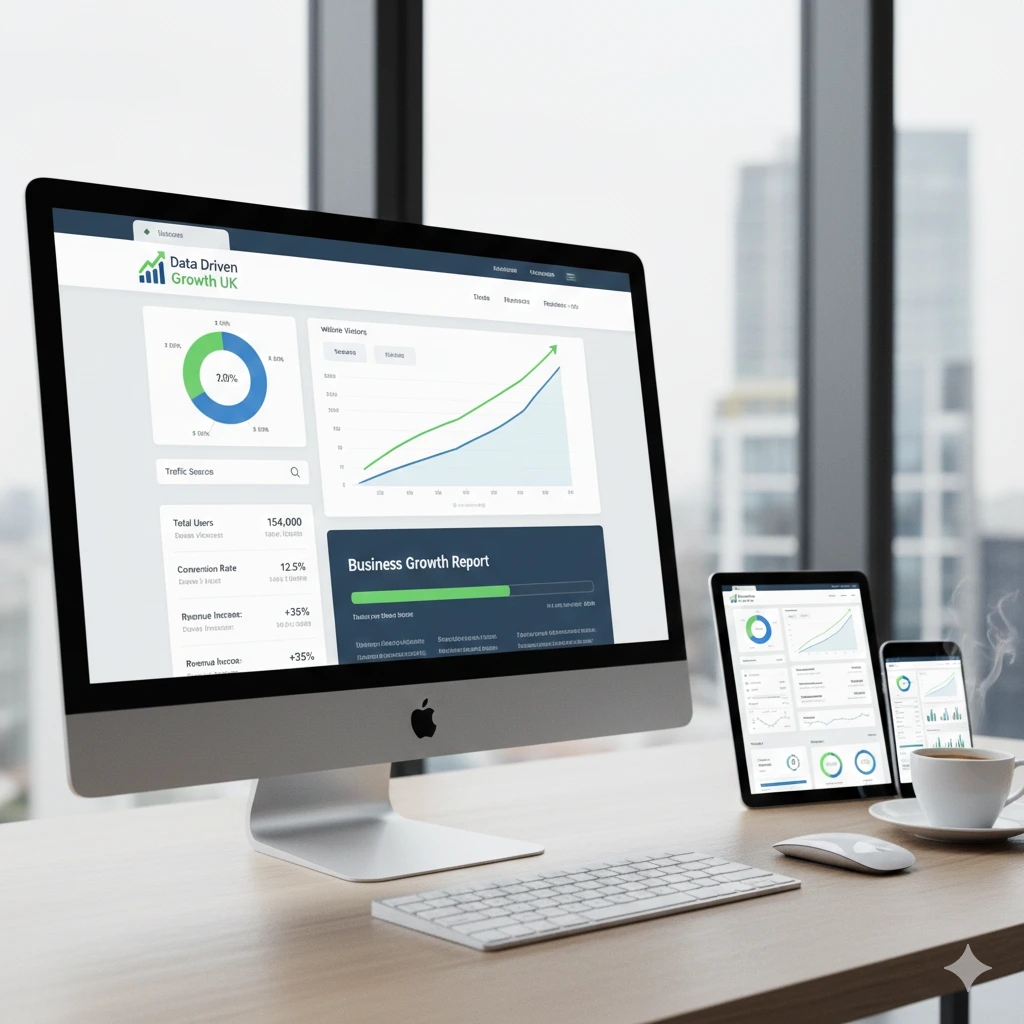
6 essential insights that instantly boost business growth
In digital marketing, getting people to visit your website is only the beginning. The next important step is understanding what those visitors do once they arrive. Which pages do they visit? How did they find your website? What content interests them? Are they completing important actions such as filling out a form or contacting your business?
This is where Google Analytics becomes valuable.
Google Analytics helps businesses collect and understand information about website activity. Instead of making decisions based only on assumptions, marketers can use data to understand visitor behavior and identify opportunities for improvement.
For businesses of all sizes, analytics can provide useful insights into website traffic, audience behavior, marketing performance, and conversions. When this information is used correctly, it can support better digital marketing decisions and help businesses grow.
6 essential insights that instantly boost business growth
6 essential insights that instantly boost business growth
6 essential insights that instantly boost business growth
6 essential insights that instantly boost business growth
6 essential insights that instantly boost business growth
6 essential insights that instantly boost business growth
6 essential insights that instantly boost business growth
6 essential insights that instantly boost business growth
6 essential insights that instantly boost business growth
6 essential insights that instantly boost business growth
6 essential insights that instantly boost business growth
6 essential insights that instantly boost business growth
Google Analytics is a web analytics platform that helps businesses understand how people interact with their websites and apps.
It can provide information about areas such as:
- Website traffic
- Traffic sources
- User activity
- Popular pages
- Engagement
- Conversions
- Audience behavior
- Marketing performance
For example, imagine a business receives 5,000 website visits in a month. Knowing the number of visitors is useful, but it does not tell the complete story.
A marketer may also want to know:
Where did those visitors come from?
Which pages did they visit?
What content did they engage with?
Did they contact the business?
Which marketing channel generated valuable results?
Analytics helps answer these questions.
Digital marketing involves many different channels, including SEO, Google Ads, social media, email marketing, and content marketing.
Without data, it can be difficult to know which activities are actually contributing to business goals.
Google Analytics can help marketers understand how different sources of traffic interact with a website.
For example, a business might discover that:
- Search engines bring consistent traffic.
- Social media brings visitors who explore blog content.
- Paid advertising generates enquiries.
- Email campaigns bring returning visitors.
These insights can help businesses decide where to focus their time and resources.
Data helps marketers make informed decisions instead of relying only on assumptions.
One of the first things marketers look at is website traffic.
Traffic refers to visits or users interacting with a website.
However, traffic should not be judged only by quantity.
A website receiving thousands of visitors may not perform well if those visitors are not interested in the products or services.
On the other hand, a smaller number of relevant visitors may generate more enquiries or sales.
This means businesses should focus on quality and relevance, not just traffic volume.
The important question is not simply:
“How many people visited my website?”
It is also:
“Did the right people visit my website, and what did they do?”
One of the most useful insights in analytics is understanding traffic sources.
Visitors can reach a website through different channels, including:
Organic Search
These are visitors who discover the website through search engines.
Organic traffic is closely connected with SEO.
Paid Search
These visitors arrive through paid advertising campaigns, such as search advertisements.
Social
These visitors come from social media platforms.
These visitors arrive through links in email campaigns.
Direct Traffic
This generally refers to visits where the source information does not indicate another referring channel.
Understanding traffic sources helps marketers evaluate different marketing activities.
For example, if SEO is generating strong organic traffic while a social media campaign is generating little website activity, the business may want to investigate why.
Traffic numbers alone do not explain whether visitors found a website useful.
Engagement provides additional context.
Marketers can examine indicators such as:
- Engaged sessions
- Time spent interacting with content
- Pages viewed
- Important actions
- Returning users
- Content interaction
Suppose a blog receives a large number of visitors but very little engagement.
That could encourage the marketer to review:
- The content quality
- Page speed
- Readability
- Internal links
- Page structure
- Call to action
Analytics does not automatically tell you exactly what to change, but it can help you identify where to investigate.
Not every page on a website performs equally.
Some pages may receive significant traffic, while others receive very little.
Analytics can help businesses identify their more successful pages.
For example:
Blog A → High engagement
Blog B → Moderate engagement
Blog C → Low engagement
This information can help marketers understand which topics are attracting attention.
A successful blog post could also inspire related content.
For example, if a blog about SEO performs well, the business could create additional content about:
- Keyword research
- On-page SEO
- Local SEO
- Technical SEO
- SEO mistakes
- Website optimization
Your best-performing content can provide clues about what your audience wants to learn.
One of the most important parts of analytics is measuring conversions.
A conversion happens when a visitor completes an important action defined by the business.
Depending on the website, this could include:
- Submitting a contact form
- Requesting a quote
- Signing up for a newsletter
- Making a purchase
- Booking a service
- Clicking an important button
For example, a digital marketing agency may consider a contact-form submission a valuable conversion.
A website can receive thousands of visitors, but if very few take meaningful actions, the business may need to improve its conversion strategy.
This is why conversions are often more meaningful than traffic alone.
Google Analytics can be particularly useful when combined with other digital marketing strategies.
SEO + Analytics
SEO can bring organic visitors to a website.
Analytics can help marketers understand what those visitors do after arriving.
This can provide insights into:
- Popular landing pages
- Content engagement
- Organic traffic patterns
- User behavior
- Conversions
Google Ads + Analytics
Paid advertising can bring targeted visitors to a website.
Analytics can help marketers evaluate what happens after people click an advertisement.
This can help businesses understand whether advertising traffic is contributing to meaningful actions.
Social Media + Analytics
Social media can drive visitors to websites through posts, profiles, and campaigns.
Analytics can help businesses understand whether social traffic is engaging with website content.
Email Marketing + Analytics
Email campaigns can bring returning visitors to a website.
Tracking website activity can help marketers understand how email traffic interacts with landing pages and other content.
A customer journey does not always begin and end with one website visit.
A person might:
See a social media post → Visit the website → Read a blog → Leave → Search on Google later → Return → Contact the business
This is why understanding user behavior over time can be valuable.
Analytics can help marketers examine different interactions and identify patterns in how people move through a website.
Understanding the customer journey helps businesses create a more connected digital marketing experience.
Analytics becomes more useful when the information leads to action.
Suppose a business notices that visitors frequently leave from a particular service page.
Instead of simply recording the number, the marketer can investigate the page.
Possible areas to review include:
- Page loading speed
- Content clarity
- Design
- CTA placement
- Mobile experience
- Trust elements
- Navigation
- Relevance to the visitor’s expectations
After making improvements, the business can continue monitoring performance.
This creates a simple cycle:
Measure → Analyze → Improve → Test → Measure Again
Analytics can provide useful audience insights.
Depending on the setup and available reporting, marketers may be able to understand aspects of their audience and how different groups interact with the website.
For example, a business may discover that mobile visitors make up a significant portion of its audience.
That insight makes mobile optimization especially important.
Another business may discover that certain content attracts visitors from particular locations.
This information can help shape future content and marketing strategies.
However, businesses should always handle user information responsibly and respect applicable privacy requirements.
A common analytics mistake is focusing on a single number.
For example:
“Our traffic increased by 50%, so our marketing must be successful.”
Not necessarily.
Traffic may increase while conversions remain unchanged.
Similarly, time spent on a page may increase because the content is useful—or because visitors are struggling to find the information they need.
This is why marketers should consider multiple metrics together.
For example:
Traffic + Engagement + Conversions + Marketing Source + User Behavior
Looking at the bigger picture provides better context.
Checking Data Without a Goal
Analytics contains a lot of information. Looking at numbers without knowing what you want to learn can create confusion.
Start with a question.
For example:
“Which marketing channel is generating the most valuable visitors?”
Focusing Only on Traffic
More visitors do not automatically mean more business.
Focus on relevant traffic and meaningful actions.
Ignoring Mobile Users
If a large portion of your audience uses smartphones, mobile performance should be monitored carefully.
Not Tracking Important Actions
If important actions are not properly measured, it becomes difficult to understand website performance.
Making Decisions Too Quickly
A small amount of data may not provide enough information to make a reliable conclusion.
Look for meaningful patterns rather than reacting to every small change.
If you are new to analytics, you do not need to understand every report immediately.
Start with a simple process:
Step 1: Set a Goal
Decide what you want your website to achieve.
For example:
Generate Leads
Step 2: Identify Important Actions
Determine which visitor actions represent progress toward that goal.
For example:
Contact Form Submission
Step 3: Monitor Traffic Sources
Understand where visitors are coming from.
Step 4: Review Important Pages
Identify pages that attract and engage visitors.
Step 5: Analyze User Behavior
Look for patterns in how visitors interact with your website.
Step 6: Make Improvements
Use the information to improve content, design, navigation, or marketing campaigns.
Step 7: Measure Again
Continue monitoring the results after making changes.
Analytics can also support content marketing.
If certain topics consistently attract visitors, they may indicate areas of audience interest.
For example, a digital marketing website may discover that articles about:
- SEO
- Google Ads
- Social media
- Content marketing
are attracting strong engagement.
The business could then create more useful content around these subjects.
This creates a data-driven content strategy:
Audience Interest → Content Creation → Measurement → Learning → Better Content
Instead of creating content randomly, businesses can use available insights to make more informed decisions.
Digital marketing is constantly changing.
Algorithms change. Consumer behavior changes. Competition changes. New platforms appear.
Because of this, marketers need to continuously learn from performance data.
Data-driven marketing allows businesses to ask better questions:
- What is working?
- What is not working?
- Where are visitors coming from?
- Which content performs best?
- Which pages need improvement?
- Which actions lead to business results?
The goal is not to collect as much data as possible.
The goal is to collect useful information and turn it into meaningful decisions.
Google Analytics can be a powerful tool for understanding how people interact with a website.
It can help businesses move beyond simple traffic numbers and look deeper into user behavior, engagement, traffic sources, content performance, and conversions.
The most successful use of analytics is not simply checking reports every day. It is about asking meaningful questions, identifying patterns, making improvements, and measuring the results.
A simple approach is:
Track → Understand → Improve → Measure → Grow
When businesses use website data effectively, they can make smarter marketing decisions, create better user experiences, and build strategies based on evidence rather than guesswork.
Data tells you what is happening. Smart analysis helps you understand why. Better decisions help your business grow.